The phenomenon of bullying is nothing new - many adults can recall being bullied in their childhood.
The phenomenon of bullying is nothing new - many adults can recall being bullied in their childhood. While ‘traditional’ bullying can involve physical and verbal abuse in the playground, our growing reliance on the Internet and connected devices means bullying no longer stops when a child leaves school. Instead, it goes online in the form of cyberbullying. Today, about 17%* of all pupils have been victims of cyberbullying attacks.
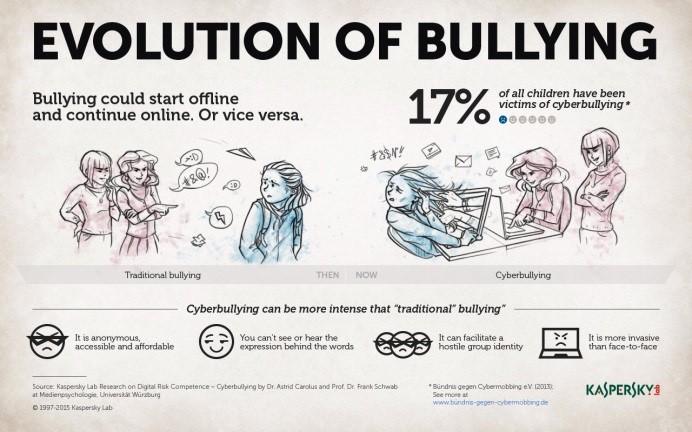
Research undertaken by Kaspersky Lab in cooperation with media psychologists from the University of Wuerzburg shows that one out of five teenagers between the ages of 12-15 have been subject to cyberbullying. This is a critical developmental stage in a young person’s life as children approach puberty and begin to spend more time online.
With the rise in popularity of social media networks such as Facebook, Instagram and Twitter, life offline is becoming more interwoven with life online. Consequently, bullying becomes harder to leave behind when a child physically leaves the playground. The bullying can start offline, at school, and continue online via social media.
As well as teaching children security techniques, it’s also important to teach them about the responsible use of technology. David Emm, Security Researcher at Kaspersky Lab explains: “Children need to develop a sense of morality when they are interacting with other people online, just as much as they do when they are communicating offline. This will give them more empathy and reduce the likelihood of them opting to engage in cybercrime or cyberbullying. It’s also important so that they understand, from an early age, the potential dangers associated with some online activities.”
Although cyberbullying does not involve physical violence, there is evidence suggesting that online bullying is even more intense than traditional bullying for the following reasons:
- It is anonymous. As cyberbullying can remain faceless in an anonymous online setting it is harder to establish the bullies’ identities and to prove who is ultimately responsible. This also means that the bullies are less connected to the damage they cause and can take things further as a result.
- It is hard to escape. Most people today have access to the Internet and all humiliating information that is stored online can theoretically be accessible forever, by everyone.
- Online all of the time. It is more difficult to escape from cyberbullying because victims are contactable via computers or smartphones, anytime and anywhere.
- It is more invasive than face-to-face interaction. The bullies and the victims cannot see each other. Consequently, they are unable to see their counterparts’ facial expressions, gestures or spatial behavior. Bullies become even more detached from the damage they are causing and as a consequence they become less concerned about the feelings and opinions of others.
The issue is compounded by the fact that two out of three children consider online bullying a real problem, but few of them will inform a trusted adult if they are being abused. Media psychologist Dr. Astrid Carolus from the University of Wuerzburg, Germany said: “Dialog is very important for young children experiencing cyberbullying. If your child is a victim, remind them that they're not alone. It's a problem faced by lots of other children. There are even a number of celebrities that have suffered and spoken openly about their experiences since.”
Bullying isn't new but technology has made it easier than ever before for bullies to attack the vulnerable. The widespread use of social networks to bring our offline lives online has unwittingly thrown fuel on the fire. The more that we learn about bullying, its causes and tactics in today’s society, the more we will be able to prevent bullies with informed and effective programs.
More information and advice on how to fight against cyberbullying can be found on Kaspersky Lab’s educational portal: www.kids.kaspersky.com/cyberbullying. This website contains useful information about bullying and educational models about the topic.
- Data Source: Germany, Bündnis gegen Cybermobbing e.V. (2013); http://www.bündnis-gegen-cybermobbing.de
