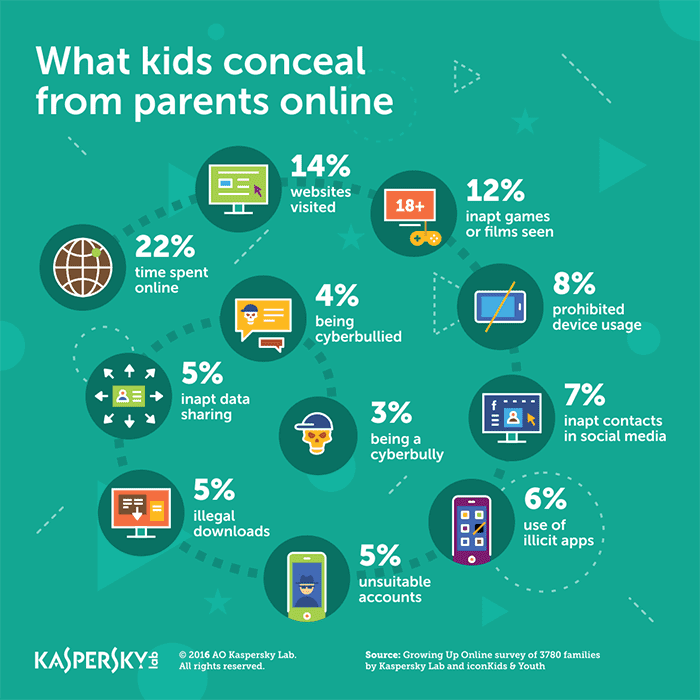
According to a survey conducted by Kaspersky Lab and the iconKids & Youth agency, almost half of children (44%) hide potentially dangerous online activity from their parents.
In a world where the Internet and connected devices play such a big role, a major part of children’s lives goes unseen by adults, presenting parents with a difficult question: How do you ensure children are raised in a secure and safe environment without intruding on their privacy? After all, a child left alone with the Internet may encounter harmful or inappropriate content. According to asurveyconducted by Kaspersky Lab and the iconKids & Youth agency, almost half of children (44%) hide potentially dangerous online activity from their parents.
The older the child, the more he or she hides. At the age of 8-10 only a third (33%) of children do not inform their parents about incidents on the Web, but that number rises to 51% for teens aged 14-16. Many parents of "uncommunicative” children remain ignorant of what their offspring encounter online. The more dangerous the activity, the less likely parents are to find out about it. For example, 56% of mothers and fathers know nothing about the actual amount of time their child spends on the Internet, while almost 70% have no idea about illegal downloading or cyberbullying.
Children not only keep silent about online behavior that is forbidden but also take measures to bypass parental control. Every third child (30%) admitted to this. They use passwords on their devices that their parents do not know, they go online when adults are away, delete the history of their online activities, etc. In addition, one in seven (14%) uses special programs that hide the apps they open.
At the same time, many children state that they do nothing to bypass parental control software. In fact, three-quarters (75%) of children find it helpful if parents talk to them about cyber threats. And that is a huge help for parents who want to protect their children wherever they are.
“Parent education plays a major role in protecting children online. If children think their parents are able to calmly discuss the issues they encounter, they are much more likely to confide in them.That’s why it’s very important for parents to find out more about online threats, increase their own cyber savviness and to build trust with their children in order to be a part of their lives, whether they are online or offline. Let children know that whatever happens, you are always there to listen, support and help. Moreover, recent research[i] from the European Commission shows that it is often children themselves who ask for parental controls to protect their younger siblings,” states Janice Richardson, Senior Advisor at European Schoolnet.
“Parental care and guidance cannot be limited to the real world only, because such a large part of children’s lives nowadays is spent online,” agrees Andrei Mochola, Head of Consumer Business at Kaspersky Lab. “For those times when parents cannot be there, they can protect their child with specialized parental control solutions. These programs not only shield children from harmful sites and apps on desktops and mobile devices but also keep parents notified about any dangers, which in turn serves as an opportunity to have a more focused talk about online threats with your child.”
For more useful advice on protecting children on the Internet, visit kids.kaspersky.com. Information about a technical solution to these problems can be found at Kaspersky Safe Kids.
About iconKids & Youth
iconKids & Youth is one of Europe’s leading child & youth research agencies. Founded in 1996, its team of experienced researchers conducts about 150 studies each year and keeps up a constant and intensive dialogue with young people under 30 and related reference groups like parents. Digital media and their effects on children and adolescents have always been a high priority in the work of iconKids & Youth. Learn more at http://www.iconkids.com.
About European Schoolnet
European Schoolnet (EUN) is the network of 30 European Ministries of Education based in Brussels. As a not-for-profit organisation, it aims to bring innovation in teaching and learning to key stakeholders: Ministries of Education, schools, teachers, researchers, and industry partners. To fulfill its goals, EUN develops, coordinates and implements a broad range of projects and services including the promotion of digital citizenship skills and broader take up of science education in schools, aiming to attract children towards science, technology, engineering and math. Learn more at http://www.europeanschoolnet.org.
1Chaudron S., Young Children (0-8) and digital technology: A qualitative exploratory study across seven countries, http://publications.jrc.ec.europa.eu/repository/handle/JRC93239
