When it comes to staying safe online, consumers aged 45 and over are more cautious than younger Internet users about sharing information, but can lack the knowledge to spot a damaging scam or imminent threat.
When it comes to staying safe online, consumers aged 45 and over are more cautious than younger Internet users about sharing information, but can lack the knowledge to spot a damaging scam or imminent threat. According to recent consumer surveys* from Kaspersky Lab, those aged 24 and under are more willing to reveal information about themselves online and take fewer steps to protect themselves, but understand potential threats better and can recognize them more easily.
The research found that for younger people, sharing data online is an everyday occurrence, with 83% undertaking private messaging online, compared to just 53% of the over 45s. Three times as many young people admit to sharing explicit content online at least once: 23% compared to 7%.
Both age groups appear to be equally careless about passwords. Around 40% say they have fewer passwords than online accounts, and around half store them somewhere insecure, for example by writing them down on a notepad.
The younger generation is more impatient when it comes to installing software and downloading files. 26% say they skip through the details of terms and conditions when installing software. This could mean that they don’t know what kind of data they have just granted access to, what additional programs they might have installed or how their OS settings could have been changed. Just 12% of the over 45s ignore the small print. Younger people also exhibit less care when downloading files, with one in three (31%) downloading files from different sources, compared to 10% of more mature users.
One in four (24%) of those aged 24 or younger would disable their security solution if it tried to prevent them installing a piece software; something only 13% of the older respondents would do.
However, according to the Kaspersky Lab research, when presented with a potential threat, younger people are more experienced at spotting malware. When asked to download a song from four samples, one in three young people (30%) chose the most dangerous ‘.exe’ file, compared to almost half (42%) of those aged over 45. The safe, ‘.wma’ option was selected by just one in five of the older users, but 29% of the younger ones.
It is not surprising that in the light of their less restrained online behaviour, younger people are more likely to find themselves hit by a malware infection. 57% of under 24s were affected in 2015, compared to 34% of older users. Due to their lack of experience with online risk, older victims of malware were more likely to say they didn’t understand how they had become infected: 17% compared to just 10% of the under 24s.
“While it is clear that more mature Internet users are likely to take fewer risks with their personal information online; when confronted with a cyber-threat they are less cyber-savvy about identifying and dealing with it. There is no substitute for having a strong digital protection instinct. It is important that users of all ages are cautious and vigilant online and aware of the potential threats, regardless of how often they use the Internet and what they use it for. People should also have a security solution in place that provides them with total protection when downloading and installing files and communicating online,” comments David Emm, Principal Security Researcher at Kaspersky Lab.
To help users protect their online lives and avoid problems caused by an inability to identify possible threats, Kaspersky Internet Security – Multi-Device and Kaspersky Total Security – Multi-Device solutions protect consumers against the very latest malware and internet threats with the help of Kaspersky Lab’s world-renowned security intelligence.
You can check your own level of cyber-savviness here: https://blog.kaspersky.com/cyber-savvy-quiz/. To read more tips on how to protect yourself online, click here: https://blog.kaspersky.com/tag/cybersavvy.
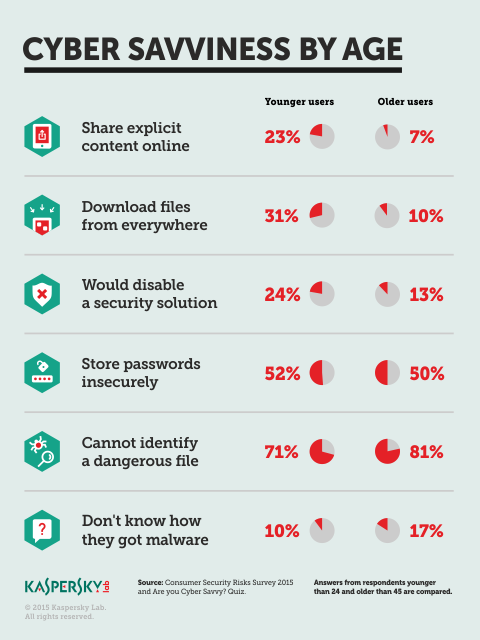
*Data is taken from Consumer Security Risks Survey 2015 and Are you cyber savvy? Quiz.
